

Supported by funding from the British Council’s Going Global Partnerships programme for a project led by Newcastle University (UK) in collaboration with TED University (Turkey) (TNE2024-041).
CLICK HERE TO SUBMIT YOUR ABSTRACT (DEADLINE: JULY 28, 2025)
*The official language of the conference is English. Participants are expected to present and engage in discussions in English.
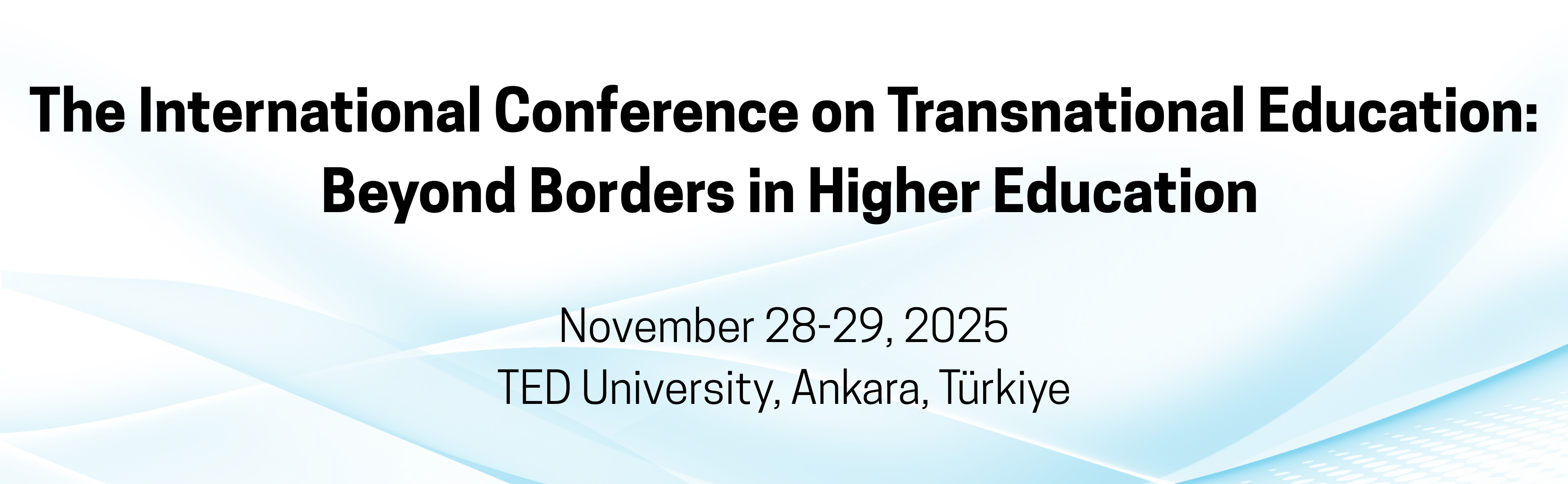
The International Conference on Transnational Education: Beyond Borders in Higher Education will bring together key stakeholders, including higher education leaders, academics, Transnational Education (TNE) experts, practitioners and researchers, to share insights into emerging trends, challenges, and opportunities in Transnational Education (TNE) and internationalisation. Transnational Education (TNE) refers to all types of higher education study programmes or sets of courses of study, or educational services delivered in a country different from where the awarding institution is based (Knight, 2016; UNESCO/Council of Europe 2000). This includes branch campuses, online learning, franchising, joint degrees, and other cross-border education models (Wilkins & Huisman, 2012). TNE is driven by globalization, the internationalisation of higher education, and the demand for diverse learning opportunities beyond national borders (Marginson & van der Wende, 2007).
This conference aims to enhance awareness of higher education systems and TNE opportunities by:
- encouraging the diversification of TNE provision
- exploring processes, frameworks, and guidelines for TNE collaboration
- discussing strategies to develop inclusive, modern and global quality curricula
- addressing accessibility, equity, and Sustainable Development Goals (SGDs) in TNE programme development
We also invite contributions on topics such as internationalisation strategies, transnational education models, and global partnerships in higher education.
Why attend?
Participants from higher education institutions worldwide will have the opportunity to connect with global experts and stakeholders in TNE, exchange research and practice ideas in international education, explore potential collaborations for future academic partnerships, and engage in discussions on the latest developments, evolving expectations, and necessary adaptations to meet the growing demands of transnational education and internationalisation in higher education.
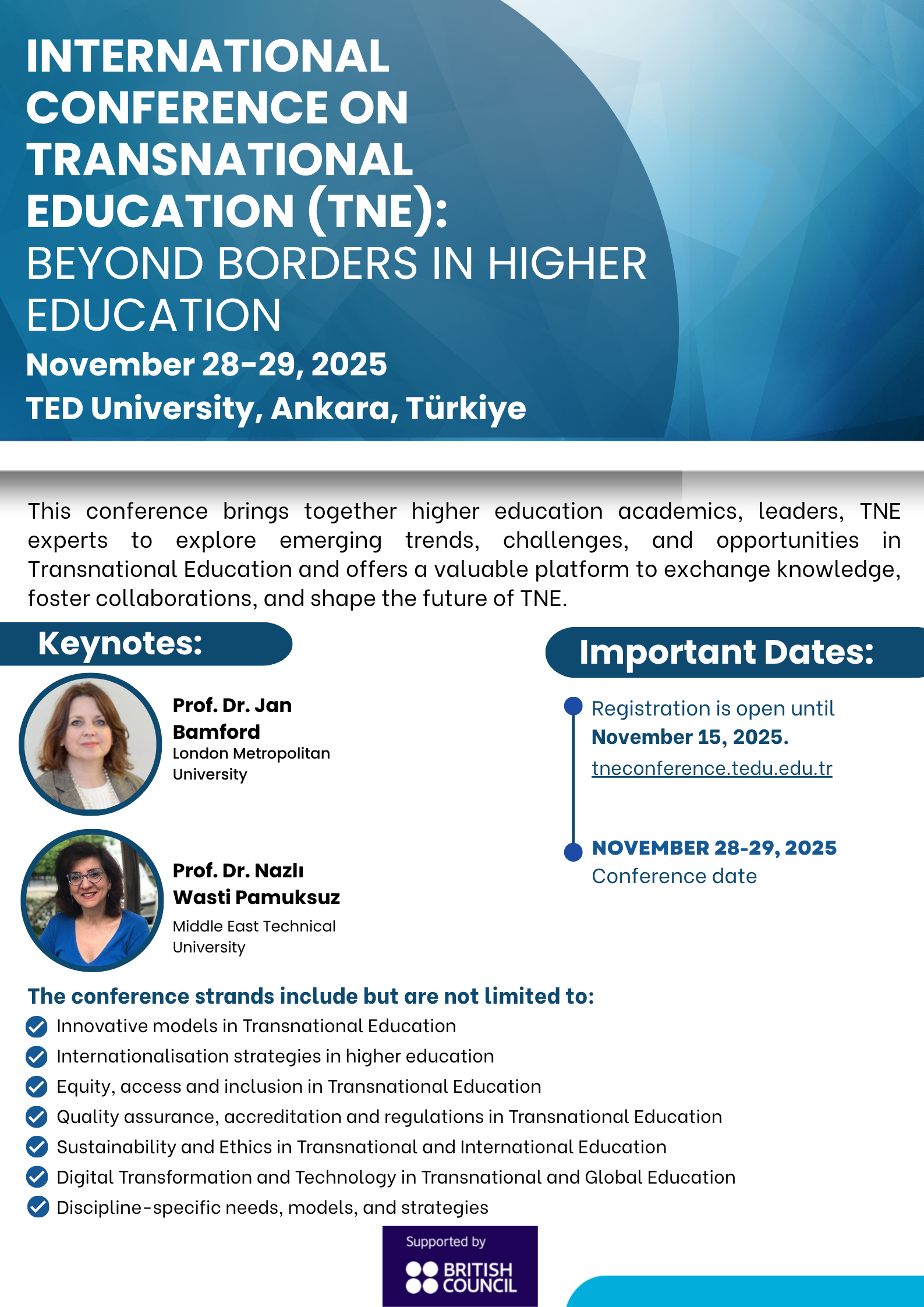
The conference strands include but are not limited to:
Transnational Education
- Innovative models in Transnational Education
- Equity, access, and inclusion in Transnational Education
- Quality Assurance, Accreditation, and regulations in Transnational Education
- Sustainability and Ethics in Transnational and International Education
- Digital Transformation and Technology in Transnational and Global Education
- Discipline-specific needs, models, and strategies
- International joint and dual degree programmes
Internationalisation strategies in higher education
- Virtual exchange, COIL, and digitally-supported forms of internationalisation
- Cross-border academic cooperation and joint/double degree programmes
- Internationalisation at home: curriculum, pedagogy, and campus life
- Intercultural communication and global competence development
- Institutional strategies for internationalisation
- Multilingualism and language policies in internationalised settings
- Inclusion, diversity, and equity in internationalisation practices
- Internationalisation and its local/national impact
- Policy studies on internationalisation in higher education
- Digital transformation and technology in global education
Conference Highlights:
- Keynote speeches: Renowned experts will share insights on the strategic role of TNE in higher education internationalisation (see keynote speaker details below)
- Panel Discussions: Exploring the role of TNE in the UK and Turkiye, as well as the experiences from designing and delivering joint degree programmes.
- Paper and poster presentations: Peer-reviewed presentations on TNE-related research, case studies, and innovative collaborations.
Prof. Dr. Jan Bamford

Her professional website: https://www.londonmet.ac.uk/profiles/staff/jan-bamford-/
Jan Bamford is a Professor of International Higher Education and has held management roles such as Deputy Dean, Head of Student Experience and International Coordinator at London Metropolitan University Guildhall School of Business and Law. She has taught Intercultural Communications both in the UK and France and more recently Inclusive Leadership and Citizenship and is a visiting professor at the Universite de Savoie, Chambery, France. Jan has co-authored numerous journal papers as well Cultural Journeys in Higher Education: Student Voices and Narratives, Emerald Publishing, (2019) and Improving and Understanding the Student Experience: Navigating the Third Space, London: Routledge (2022). She has also authored Joint Degrees and International Transitions in Higher Education: The Self, Pedagogy and Culture, Palgrave MacMillan (2020). She is a leading specialist on students' cultural experiences of higher education and understanding and dealing with difference in higher education spaces. More recently Jan has worked with students as co-designers and co-creators in their learning spaces, as a way of unpacking the rich and dynamic aspects of the students’ cultural journeys through the development of gamified digital learning tools. Jan’s previous work has looked at the cultural experience of international students in France and the UK. The different country context allowed for an enriched understanding of higher education spaces in a globalised world. Jan has combined her teaching and learning focus with an applied research approach in order to understand and explore in more depth the lived reality of the student experience. Jan is founder and Co-Director of London Metropolitan University’s Higher Education Research Group (HERG). Through her work with HERG, Jan is able to support colleagues in building their educational research projects and enhance the impact of that research. Jan has been a PFHEA since 2014 and has recently been awarded a National Teaching Fellowship (NTF). She is a founding member of the Interdisciplinary Research in Assessment Practice Group (INRAP), and Hon. Visiting Prof. for the Communications Institute of Greece.
Reaching beyond borders in a shifting global landscape: daring to reimagine the possibilities of transnational higher education
Abstract
The landscape of transnational higher education (TNE) is a dynamic and multifaceted field that touches on economic, socio-cultural and the academic pressures that remain deeply rooted in national contexts. In an era marked by geopolitical tensions, UNESCO continues to champion quality education and lifelong learning opportunities for all. We will consider how TNE can reach beyond borders, offering new possibilities for internationalisation and expanding access to higher education across diverse institutional settings.
The growth in TNE, warrants increased attention both through the theoretical framing of those educational spaces and through the promotion and experience of the transformational opportunities that they represent. For the UK alone, TNE represents a significant income stream, with growth of 123.9% between 2010 to 2021. The UK Dept of Education cites the economic worth of TNE as £20.6 bn in 2021, with a goal of achieving 50bn by 2030.
TNE permits higher education to exist in spaces that enhance and increase opportunities for those who participate in institutional contexts. As Marginson (2022) observes, many different kinds of global convergence and integration exist in the context of global higher education. For example, there are hierarchical vertical relations and flat horizontal networks that are nation-centred, despite their international reach. The complexity of the typology is a facet of the transnational higher education landscape. The interconnected challenges and opportunities offered through transnational education spaces demand further exploration through the different models presented, as well as how education is experienced and received by those staff and students who partake of it.
We will consider models of TNE delivery and the lived experiences of staff and students within these transnational spaces, exploring the current debates around internationalisation, addressing the benefits, challenges, and tensions that shape the evolving landscape of global higher education.
Prof. Dr. Nazlı Wasti Pamuksuz
Her professional website: https://ba.metu.edu.tr/en/people/full-time-faculty/nazli-wasti-pamuksuz

Professor Nazlı Wasti is a faculty member and department chair in the Department of Business Administration at Middle East Technical University (METU), with a career that spans scholarship, international collaboration, and academic leadership. She has been engaged in various international experiences, having taught in Japan, Sweden, and the UK as part of Erasmus+ mobility programs and conducting research as a visiting scholar at the University of Tokyo through a Japan Foundation Fellowship. Nazlı has been involved in two Newton-Katip Çelebi grants with the UK and was the local coordinator in an Erasmus+ Strategic Partnership project with collaborators from Turkey, the UK, and the Netherlands, aimed at developing the case method in management education in Turkish universities. This project was later supplemented by a British Council Connect4Innovation grant, where Nazlı led the METU team. She served as the national representative of the European Academy of Management (EURAM) between 2017 and 2020, and was the local director of the METU Confucius Institute from 2011 to 2018, where she played an active role in advancing cultural and educational exchange between Turkey and China. In recognition of her contributions, she was honored with the Hanban Individual Personal Excellence Award in 2012.
Her research interests include interorganizational trust, trust repair, innovation management, and management education, with her work appearing in leading journals such as the Journal of International Business Studies, Research Policy, and the Journal of Product Innovation Management. She has been a member of the editorial board of the Journal of Trust Research since 2013. Her most recent work with international collaborators has focused on the usage of case studies in teaching; she has co-authored a book chapter on building an international community to support participant-centered entrepreneurship education in Turkey as well as two conference papers exploring learner responses to female protagonists in case studies. She holds degrees from METU, the University of Missouri-Rolla, and the University of Michigan-Ann Arbor, and teaches courses in operations management, organization theory, supply chain management, and innovation management at the undergraduate and graduate levels.
Tensions in Translational Education (TNE): A Paradox Lens
Abstract
Transnational Education (TNE) has become a prominent form of higher education internationalization, with universities increasingly establishing cross-border partnerships, joint programs, and branch campuses. While these collaborations promise academic, economic, and societal benefits for both home and host institutions, they also embody inherent tensions. When faced with tensions of competing demands, the typical response often revolves around attempting to achieve a balance between the two poles (“both/and”). Yet when this is not possible, favoring one pole over the other (“either/or”) becomes inevitable, causing the neglected side of the argument to fade into oblivion, harming the chances of survival for the TNE arrangement.
This talk will explore such tensions through the lens of paradox theory, which views persistent tensions as potentially fertile, rather than merely problematic. I will first present how paradoxes arise, and then identify a number of commonly observed home–host paradoxes in TNE arrangements, such as standardization versus contextualization of curricula, control versus localization, local versus home staff employment, and criteria for student recruitment. I will next illustrate how paradox management strategies such as acceptance/opposition, spatial separation, temporal separation, and synthesis can act as lenses to help navigate these competing demands.
While the “either/or” approach to a paradoxical situation could also be deemed appropriate depending on the circumstances, this talk will highlight how a broader repertoire of paradox management tools can enable more sustainable and harmonious TNE collaborations. By embracing rather than eliminating tensions, institutions can transform TNE into an opportunity for shared learning, experimentation, and innovation.
Important Dates:
Abstract submission deadline: July 28, 2025
Presenters notified of outcomes: August 13, 2025
Registration opens: August 15, 2025
Registration closes: November 15, 2025
Contact and Additional Information
For questions and updates, contact us at the email below:
tneconference2025.tr@gmail.com
Follow us on Social Media for the latest updates:
X: tne_tedu_ncl
Bluesky: tne-tedu-ncl
Instagram: tne_tedu_ncl
We look forward to welcoming you to Ankara, Turkiye for insightful discussions on shaping the future of Transnational Education!